Shigefusa 270mm kasumi yanagiba with custom, by me, desert ironwood handle

18 Nov 2010

Oohira Shiro Suita 210x80x20mm #40-42000

This is the first post presenting each stone in my range of japanese sharpening stones. First rock out is also the first japanese natural sharpening stone I bought, and I got it from Takeshi Aoki at Aframestokyo.

According to Mr. Aoki it's a very old pre-owned suita stone from the Oohira mine. It has a mustard or Kiita colour on the surface, but from the side it looks like it is an egg shell white, showing some renge or lotus towards the bottom, so the yellow colour is probably just oxidation and it a most likely a Shiro Suita. That would explain the exeptional hardness and very fine grit of this beautiful stone.

As you will see, I have mounted all my stones ,exept from a couple of two sided ones, to wooden bases (made by quartersawn Sibirean Lodgepole Pine) of exactly the same length. This eases up the sharpening process as I don't have to adjust my sink bridge for every new stone. I adjust the sink bridge for the first stone and the standardized bases allows me to just slip in new stones in a second. This base mounting also brings the shorter coppa stones towards me as I mount all stones equally distanced from one end of the base, giving me a lot better control and consistency in the contact between stone and knife.

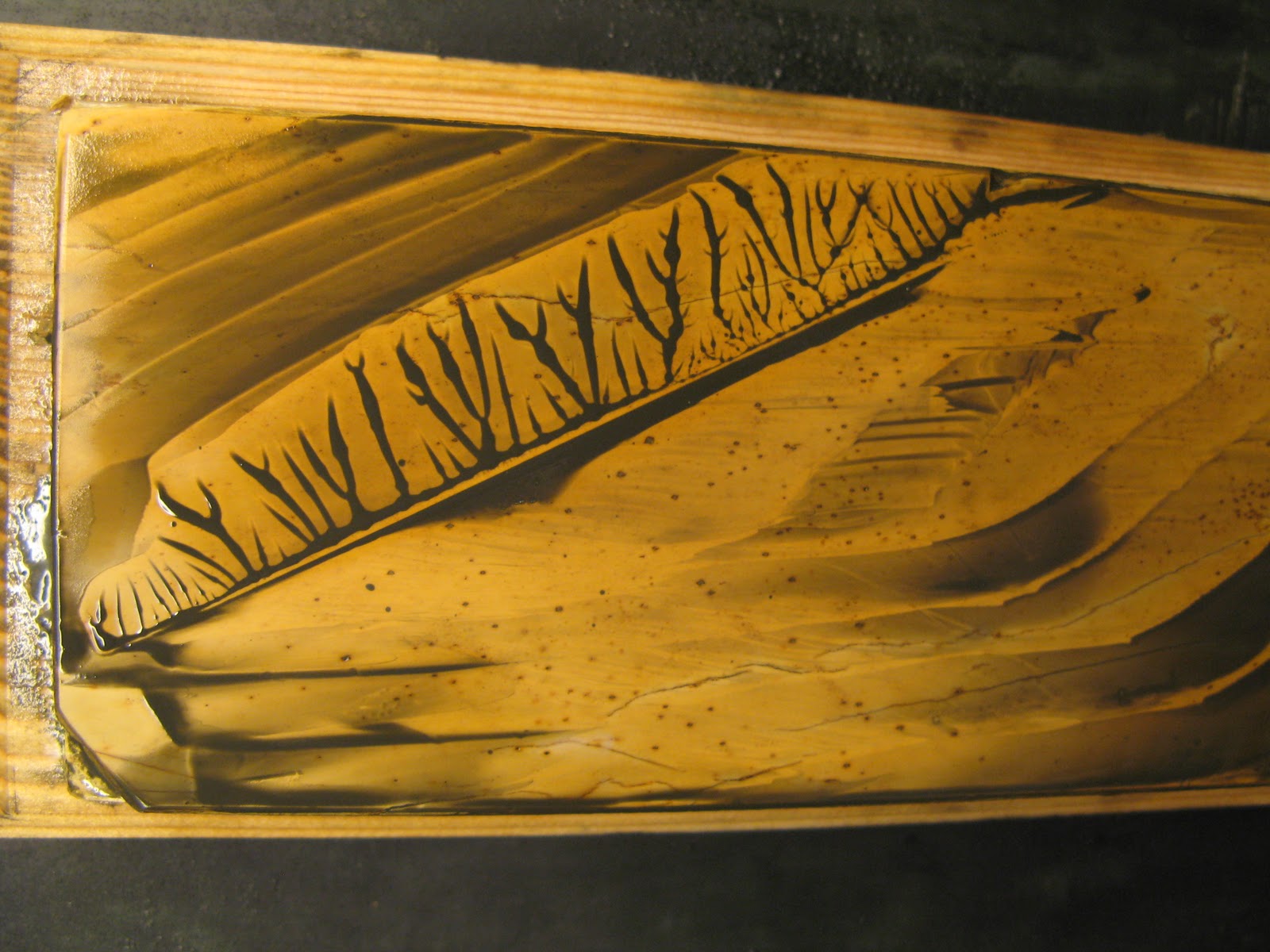
The stone is very aggressive and pulls black iron filings from the first stroke, even without using a nagura. In the first picture below you can see the metal filings suspended in still clear water after just 10 passes over the stone. After about 25 more passes a black slurry is produced. Quite impressive for a stone this fine.


As you can see the stone has the usual su holes making it a suita. However, the stone is very clean without inclusions or renegade particles and with very few lines which are not at all affecting sharpening. It feels like it virtually sucks especially white steel into the stone, making a perfect connection between steel and stone. The  stone also performs exeptionally well on blue steel and AS.

The stone finishes a kasumi to a very nice mist and haze making beautiful contrast between Jigane and Hagane and giving the edge a high grade of polish. Grit size is according to Japanblade definitions probably in the #40-42000 grit range. In the 330mate world it would be HGAL=5++/3++++/3++++/3++++. You can see some light scratches, but that is probably residual from a coarser stone.

As you can see the Oohira finishes the edge to a very nice and even finish. Just the right amount of light mist. This semi polished look is actually due to a very fine and complex scratch pattern from the natural stone. Looking at the close up picture above, the surface is actually matte or hazy to the look. This highly complex scratch pattern I believe is one of the main factors to get the edge really sharp and more wear resistant than an edge polished to a full mirror finish by fine synthetic abrasives. You can find some very good reading about this theory here http://thejapanblade.com/sharpvsshiny.htm. The edge off this stone gets the characteristic "stick" to it making it just slide effortlessly through sashimi or tomatoes rater than cutting them. It is absolutely amazing.

When using a diamond nagura pulling up a slurry and just letting it dry up, the colour of the powder is white, almost like potato flour. Another sign of a Shiro suita.

It goes without saying that this is one of my most treasured stones. It has become the reference I compare other finishing stones to.

16 Nov 2010

My current collection of yanagiba knives

As I have mentioned earlier, out of all the Japanese knives the yanagi knife is the one closest to my heart. I just love the lines and the balance in well made yanagiba. The way it instantly becomes an extension of my hand almost feels like magic. The feel of a well sharpened blade easily slicing through fish leaving a shiny, almost oily surface totally free of tear and damage to the delicate flesh is really satisfying. Here is a picture of my current collection of these fascinating knives.

I will describe them briefly starting at the top:

1. Keijiro Doi 80th anniversary 300mm hayate kengata mirror finished yanagi. Number 4 of 5 made. White steel #1 (Shiro ichi ko). Octagonal Macassar ebony handle with blonde water buffalo horn bolsters. Collection piece, never used. Hardness HRC64-65.

2. My latest project. A refurbished 40++ years old 300mm mirror finished yanagi. Claimed to be true tamahagane steel, but more probably very high quality blue steel #1 (Aoko). Custom made (by me) octagonal Macassar ebony handle with silver inlays and black water buffalo horn bolsters. Hardness HRC63-65?

3. Sakai Gyutoko 300mm Honyaki mirror finished yanagi by master blacksmith Kasahara. From the shop of Tomohito Iida, Iida tools i Japan. If you are in the market for professional tools from Japan, I can recommend his shop. Excellent service, excellent tools, very reasonable prices. http://www.japantool-iida.com/ .The knife has a beautiful ripple line on both sides two thirds up the blade, so I have a lot of hardened steel here. A blade to pass down through several generations. My go-to yanagi. Gets incredibly sharp and stays sharp "for ever". White steel #2 (Shiro ni ko). Octagonal Ho-wood handle with black water buffalo bolster. Hardness HRC63-65.

4. Shigefusa 270mm kasumi yanagi by Tokifusa Iisuka. Special Swedish steel alloy by Shigefusa. Beautifully polished with Japanese natural stones to a silky matte finish.  Custom (by me) octagonal handle of desert ironwood with silver inlays and vlack water buffalo horn bolsters. Absolutely perfectly balanced and a fantastic knife. Hardness HRC64-65?

5. Masahiro 240mm kasumi yanagi. My very first Japanese style knife. I bought this more than 10 years ago and for many years this was my only Japanese style knife. Started out as a yanagiba but after 10 years of sharpening it looks more like a fuguhiki. Blue steel #2 (Aoko). Custom (by me) octagonal Macassar ebony handle with black water buffalo horn bolster. A very light and easy knife to use. Hardness HRC62-63.


15 Nov 2010

Making good use of my knives

The knives I collect are all masterpieces of Japanese art and craft. Exeptional skill is required to make them. To just put them on display would be a pity, almost a crime. It's like collecting Ferraris without ever driving them. So, I extended my culinary journey and started experimenting with sushi and sashimi. In addition to being a lot of fun and very tasty, it is also the perfect way to find out how the knife performs after sharpening. It is not always enough to get a knife sharp.

A yanagi can be incredibly sharp and still be a poor performer on sashimi. The finishing, edge shape and grind can have huge impact on cutting performance. A totally flat, mirror polished bladeroad, for instance, is often useless, as the thin fish slices sticks to it and gets torn up.

To my experience a pronounced hamaguriba, or clam shell shape, on the edge and lower part of the blade road combined with a blade road finished to a #3000-6000 grit works best, by releasing the fish slices easily. The cutting edge should still be polished with a very fine finisher higher than #10000 and be razor sharp.

Below picture shows an early attempt on nigri and maki sushi. I am especially happy with the salmon slices, as I managed to get almost identical pattern on all. Luck? No, it's Shigefusa! :oD

Knives, knives, knives!

As I have already mentioned, one of my greatest passions is about japanese knives. Collecting, sharpening, rebuilding and using them. I just love the sleek shape, excellent balance and incredibly sharp edges of the yanagiba. A well made yanagiba instantly feels like an extension of your hand, and I turn into som kind of Edward Yanagibahand :o)

Of course I can't do with only yanagibas in my kitchen as I have a much more varied diet than raw fish fillet. I am not a darn cat!  Therefore different shapes of knife for different uses keeps invading my kitchen to my girlfriends despair. The picture below shows a variety of knives from my collection, which keeps growing :o)


The three knives to the left  are my trusty working horses and go-to knives. A really beautiful and very professional set. Bought from Tomohito Iida at Iida tools in Japan. A businessman with an unsurpassed level of service. Recommended!! So, from the very left, a blue steel kasumi style 180mm Deba for dismantling fish and poultry, then a blue steel kasumi style 210mm Usuba for veggies and finally a white steel Honyaki 300mm Yanagiba for sashimi. All "Sakai Gyotoku" knives by blacksmith Kasahara san. I was thinking about cusomizing the handles on these knives as well, but they are so perfectly well made and perfectly shaped and balanced that I really don't dare starting to fiddle with them. I can't possibly do better than this. These knives are true pieces of functional art, and I can almost feel the blacksmiths soul when picking up the honyaki. It is the materalisation of the Japanese will to perfection urging me to do my very best when using it.

The three knives in the middle are from the left, my very first yanagi, a small Masahiro blue steel knife. Then a Monzaburo white steel #2 kiritsuke custom handled by me, and finally the jewel of my collection, A Keijiro Doi 80th anniversary white steel #1 (shiro ichi ko) 300 mm kensaki yanagi hayate. One of only five made. My knife is #04/05. Master blacksmith Keijiro Doi is now retired, making this knife a real collectors piece. I feel honoured and humble to own one of his masterpieces. Actully I feel honoured and humble to own each and every one of these beautifully crafted knives.

The three knives to the right are a nashi-ji Santoku, a nashi-ji Nakiri and a mirror finished Wa Gyuto, all by master blacksmith Junichi Takagi. All three knives are Honyaki blue steel #1 and custom handled by me in ebony and water buffalo horn. Very light and versatile blades, incredibly sharp and with exeptional edge retention.

Japanese natural sharpening stones

A natural extension of my knife collection is ofcourse collecting stuff to keep the knives as sharp as possible. Thus, I have started collecting Japanese natural sharpening stones of various grits, shapes and quality. Large size, perfectly rectangular, high quality stones are usually exceedingly expensive, so I have to compromise.

A large size, perfectly rectangular, crap quality stone does no good to any knife, so I try to score the really high quality sharpeners in small, thin or odd sizes, as you will see from the pictures. Of course I have a jewel or two that took away the best part of a months salary, but they will last me a lifetime and then some.

Two of my main rocks. To the left an Oohira shiro suita #10000+++ grit, and to the right an Oohira Asagi #6-8000 grit.

Below is my wonderful Aoto. 240x95x95 mm and weighing in at 4,7kg (9 pounds). Totally homogenous and exeptionally efficient for an Aoto. The 300mm yanagiba blade from my latest project placed on top for comparison.

Below you can see the grind marks from the Aoto. Dense, shallow, homogenous grind marks easily removed by the Oohira Asagi.

My latest knife project: A 40++ year old 300mm tamahagane/ blue steel yanagiba

My latest project is a total rebuild of a 40+ year old yanagiba blade that had been sitting on the shelf of an old blacksmith and hastily refurbished for sale. I bought it because the price was right and I needed a project like this to explore the different qualities of my Japanese natural stones. When I got the blade it was quite thick and chunky and the profile was a bit wonky with a very pointy and fragile tip. It was very crudely ground and the machi (heel) was not finished at all.

The first thing I did was to redraw the shape of the blade. I did a total regrind of the blade and after going through the stones up to a full uchigumori finish, i gave it a mirror finish. Then I built a new handle and a new saya for it (still in the making). The seller stated that the steel was true tamahagane, but that is not very likely. It is probably a blue steel variety. That said, the edge is even harder than my shiroko honyaki @HRC 65, and takes an absolutely incredibly sharp edge. This is very possibly my sharpest blade to date. Even sharper than my Doi Shiro #1. Some pictures from the process below. Enjoy.

Before: Note the odd "hanging" profile of the knife including the handle. It almost looks a little bit depressed :o)


After: The profile is "straightened out" to a more balanced appearance

Before: Ugly machi...

After: Polished machi :o)

Before: Really rough grind...

After: Mirror finish :o)

In the below picture you can see the reflection of my ceramic wall tiles in the blade. Note the semi polished blade road. Towards the very edge you can see the reflection lines from the tiles "bend" a bit due to the hamaguriba (clam shell) sharpening. The reflection amplifies the hamaguriba curve significantly because the blade is held askew related to the tiles, but it shows the principle of hamaguriba.

Before: Simple handle... not at all bad, tho'. Ho wood and water buffalo bolster.

After: Custom (by me) Macassar Ebony octagonal handle with silver inlays and water buffalo bolster :o)