Shigefusa 270mm kasumi yanagiba with custom, by me, desert ironwood handle

Labels

Showing posts with label Test. Show all posts

25 Apr 2012

Marko Tsourkan Designs 240 mm Wa Gyuto 52100

Marko Tsourkan from NY should be no stranger to many of us knife nuts. He is a well renowned and very skillful maker of handles mainly for kitchen knives. Further he is a perfcectionist to his very fingertips and his impeccable work stands as a reference to many of us in the knife collecting/ using/ sharpening business.

Since last year Marko has expanded his business, toning down the handle making and starting up the design and production of a line of knives for the professional chef. His goal is to equal or surpass the cutting ability of the Shigefusa while using modern PM steels that will allow for an unbeatable edge wear resistance and ease of sharpening. Just what you want in a professional kitchen. You want a knife that cuts about anything pretty effortlessly (is that a word?), is easy to sharpen and stays sharp for a full shift in a busy kitchen. You want a knife with these qualities that is versatile, so you can do with fewer knives. (Who would possibly want fewer knives, you ask, but you know what I mean).

All this sounds amazing, and when I heard that Marko would start making knives, I knew that something great was in the making. Marko spares nothing to make things perfect. He designes his very own line of knives based on the best production and semi custom knives out there, choose his steels after extensive testing and discussing with the most renowned makers in the business, and finally experimenting shamelessly like a mad scientist with heat treatment to get the exact results he wants; the perfect blend of edge retention, sharpenability and sharpness. Add that to Marko's perfectionist mind when it comes to design, fit and finish, and you have the Marko Designs line of knives. Ta-daaa!
The Marko Tsourkan Design Gyuto and diamond loaded felt strop
Judging by this knife I have been able to review for a while now, Marko is getting very close to attaining his goal in all of the above aspects. Looking at the picture above it is easy to see that one of Marko's main sources of inspiration is the japanese gyuto and in particular the shape of the Shigefusa. However, Marko has refined the design further making the blade a tad thinner and lighter, thus making the knife lighter on the hands and arms during extended use. As you can see the blade takes a beautiful patina pretty quickly but it has very low reactivity to most foods (all I've tried anyway).

The handle design is pretty new for Marko, who is best known for his octagonal Wa handles. They are as perfect and beautiful as they are simple. The new design is no exception in this regard. Perfect but simple.

As mentioned, on this particular knife the octagonal handle is replaced with an experimental (yet traditional) D shaped handle but with a Kramer-ish taper to the ferrule, which aids the pinch grip on the blade. The perfectly rounded choil and spine aids this even further, making the knife an absolute joy to hold and use for extended periods of time, and the perfect tapering from heel to tip gives the blade a very good and balanced feel in the hand. It just falls right into a very comfortable pinch grip while also serving those who prefer to grip the knife just by the handle. Well done!


Regarding the thickness of the blade, it falls nicely inbetween the Shigefusa, which some may find too hefty, and my refurbished 240 mm Shiro #3 laser gyuto, which some might find too light. I believe Marko has found a thickness that will suit a lot of users perfectly.

After using the knife for several different tasks in my home kitchen for a couple of weeks I decided to put it to a more comprehensive test to get a feel of what this knife was able to do and to uncover its strengths and weaknesses.

I used my professional hard polyethylene cutting board which is pretty hard on the edge, but which is found in many professional kitchens. This would test the edge wear resistance pretty good. I also chose different vegetables to test different parametres of the blade. Chillies with tough skin, Cabbage and swede cabbage to test wedging, tomatoes to test edge sharpness and some overgrown fibery sugarsnaps to test chopping-ability. Finally I added some cheap pork cutlets to the setup to test the blade in raw protein.
Set up for making a nice casserole :o)
I started by sharpening the blade on my trusty Aka-pin stone (#6-10000 range somewhere). This little stone has really become my go-to stone for all kinds of steel. It is exceptionally efficient even on very hard steels and leaves a very refined edge, yet with a nice bite to it.


I finished the edge on the Marko Designs felt strop. This stone-strop combo showed to be a match made in heaven and gave me a scary sharp edge that easily shaved the hairs of the back of my hand. I have never been a fan of strops, always finishing on stones, but this diamond loaded felt strop from Marko really opened my eyes. The initial cherry tomato test went flawlessly. Easily slicing a standing cherry tomato only held by its own weight. After this confirmation of the edge I went to the real test.


First I went to the swede, the purple thing to the right on the cutting board. Despite its misleading name, it is a root fruit used in a lot of traditional Norwegian dishes and the size and hardness of this massive bulb will really put any blade to the test regarding wedging and skewing.


The Marko gyuto cut through the swede effortlessly without any apparent wedging or skewing at all. It slid straight through. The blade seems perfectly neutral left to right.Cutting paper thin slices was also easy and the blade handled very well. A skewing blade would easily have been discovered in this test.

Next up was the white cabbage. This cabbage was exeptionally dense and heavy and would be a real challenge to any knife. The Marko gyuto slid through effortlessly like with the Swede. No wedging nor skewing was apparent. Cutting angel hair cabbage was also an easy task, and the thin strands of cabbage released easily from the blade. Again the knife performed very well.
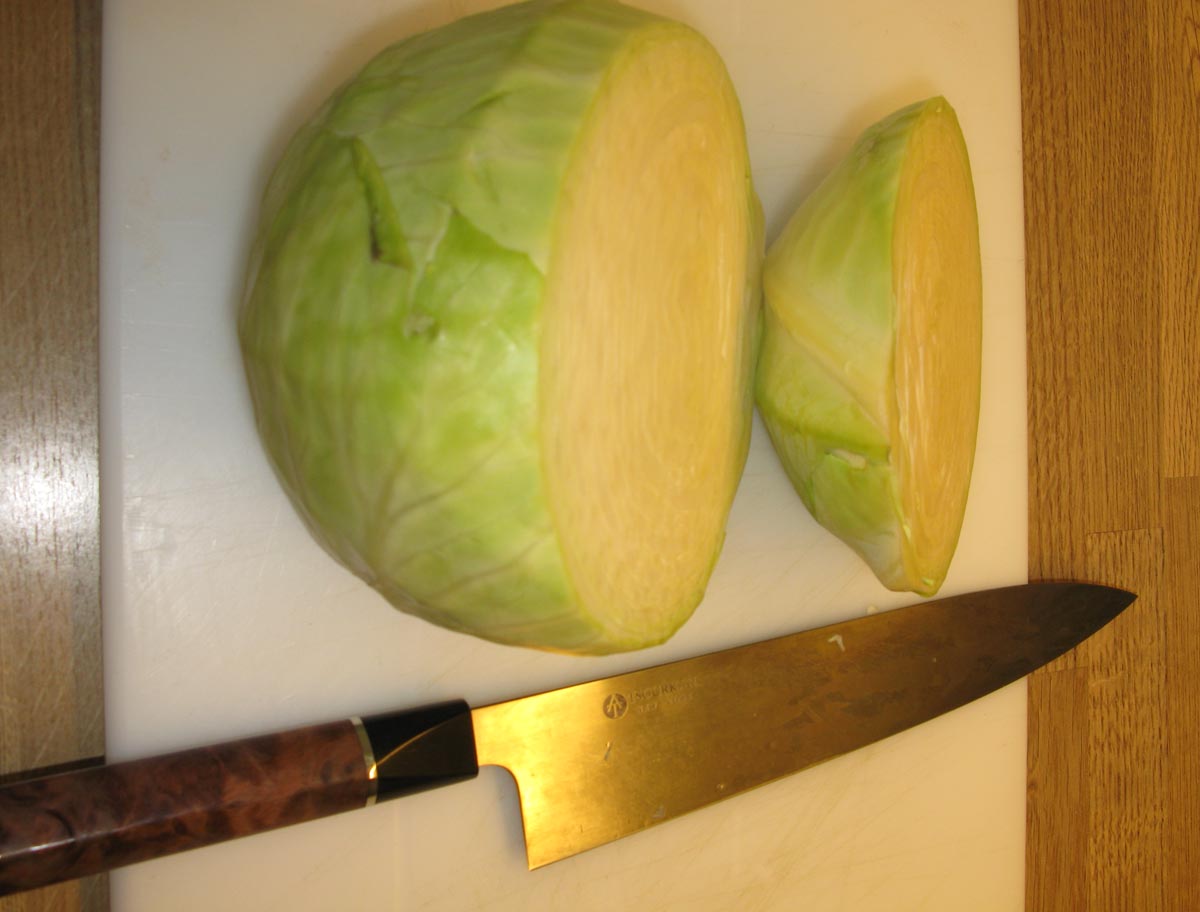


This was the produce that was really reactive with the Shigefusa kasumi cladding iron. No apparent reactivity on the 52100 steel.

The chillies and the sugarsnaps were no challenge for this powerful gyuto either. The chopping test showed that the flat part of the edge that starts at the very heel and extends almost half the blade to the tip, and with its slight angle relative to the handle, makes for a very balanced and efficient chopping blade. It is easy to find the right chopping motion and as usual it cuts effortlessly through tough chilli skin and old fibrous sugarsnaps.


The raw protein test was to se how the blade was able to cut paper thin slices of meat or fish without ripping the fibers. The knife sliced through the pork meat like butter and no matter how thin I was trying to slice, the knife performed effortlessly. Pretty impressive how versatile this knife really is. If I would have to manage with only one knife in my kitchen, the Marko gyuto is my #1 candidate to date. It is exceedingly good in anything I have tried.
You can see the spine of the knife through the thinly cut meat.
The cutting surface is without any apparent damage to the muscle fibers.
So, to the final test. Would the edge still cut a cherry tomato standing loose on the cutting board? Yes it would! Well partly anyway. The part of the edge that had been banged into the hard plastic during the chopping session had dulled slightly. For regular tomato cutting it was still very good, but this ultra sharpness test got a bit more difficult than before the cutting and chopping party.

Now to the amazing part. You see, Marko claimed that after some passes on his wonderstrop the "dulled" edge would go back to crazy sharp just like that. I was thinking "Yeah, Right!". So, just to prove him wrong, I took the blade to the strop, passed it over a couple of times on each side. First with a little pressure and then with almost only the weight of the blade.
Back side of the very well made felt strop. And check out that patina on the blade :o)
Was I ever surprised. The edge was almost totally back to scary sharp just after a few light strokes on the strop. If you get a knife from Marko, get a strop with it! If you are not getting a knife from Marko, still get a strop for your other knives.

When Marko first told me he was going all in on the knife making business I new it was going to go one of two ways. Either he would not succeed in his endeavours and give up the whole thing or he would succeed 100% and become one of the very best out there. One thing you can trust when it comes to Marko. If he decides on doing something it is because he thinks he can make it perfect. And he will not rest until he has. The knife in this review proves that. It depends of course what you personally consider to be the perfect knife. Weight, size, steel, heat treatment, handle. All things matter. What I am trying to say, however, is that this knife is perfect in what it is. The size feels perfect to the weight, the balance feels perfect to the length, the handle feels perfectly shaped and sized to the blade and the heat treatment seems to get very, very close to perfect for the steel.

Knowing Marko, I am not one bit surprised by the quality of this knife. I am, however, deeply impressed by how far he seems to have come as a knifemaker in the short while he has been making knives. He tells me he is still making adjustments to the grind to make the blade more non-stick, but from what I have been experiencing with the blade in this review a further improvement in this aspect would actually make the knife food repellent :o)

I'll round this review off with a couple of "Patinart" pictures showing off the beautiful patina on the 52100 blade and Marko's very clean and stylish brand mark. Review knife or not, I'm keeping it!!


DarKHOeK


24 Apr 2012

Full custom 300 mm damascus san mai suji - "The Black Pearl"

About a year ago I was thinking seriously about getting a full custom knife. I was not sure where I wanted to go so I searched the Internet, different knifeforums and several knifemakers' web pages. There was a plentitude of options. Some of them totally not my liking and others so costly I would have to sell my car and a kidney to get one, so quite a few options were ruled out pretty easily.

After a lot of searching I found exactly the design I was looking for in a blade. Problem was it was not a kitchen knife. It was a hunter blade. Fully forged high contrast damascus with an O1 core. The blade was absolutely stunning! By this time I had pretty much settled my mind for a sujihiki blade to complement my collection of yanagibas, and I wanted to stick to the 300 mm length as this is the length I have been accustomed to in my slicers.

I contacted the knifemaker of the above mentioned hunter, and we started talking. He was all ears about my requests and baseline design suggestions, filling me in on the gaps and finally he came up with an idea so grand I could not resist. A 300 mm sujihiki with O1 core steel encapsulated in pure nickel and direct forged in a high contrast damascus of 15N20 and 1084 steel. In this particular blade the core steel is forged directly into the centre of the damascus bar. This is a very time consuming and an immensely difficult task to accomplish, especially in a 300 mm blade, as it is almost impossible to keep the core straight and in the centre of the blade during the forging process. This was going to be a grand test of his skills as a blacksmith.

You can see the core steel gently rippling down the centre of the spine of the blade with the nickel encapsulating the core.
After one single trial run, resulting in the worlds probably most exclusive letter opener :o), he succeeded. That is nothing less than impressive, and a proof of exceptional skill as a knifemaker.

The result ended up like this. I just can't stop looking at it. It is an exceptional piece of functional art. It looks pretty hefty, but actually, the first thing my wife said when she took it up was "Wow, it's a lot lighter than it looks!". I have to agree with her on that one. It is definately not the lightest suji out there, but the balance, the forged tapering of the blade and the weight and shape of the handle is so well executed that the knife immediately feels like an extention to your hand.
"The Black Pearl" in all its' splendour with the stunning Stingray saya. It is truly a one-of-a-kind knife
Most of you will recognize the brand mark on the certificate. The Bear paw. Many of you will also recognize the special rounded choil and the full grain leather saya design. The blacksmith and knifemaker is of course Mr. Pierre Rodrigue from Canada. A true master of his craft and a true gentleman to his trade.
The Bear paw of Mr Rodrigue's brand. Look also at the incredible damascus pattern.
Remember that the damascus pattern is forged with the core in. That is pretty impressive stuff!
Total production time was about one year from start to finish. The extensive production time was partly because Mr. Rodrigue is a very busy man and a popular knifemaker, partly because the forging of the blade is an exceedingly complex matter, partly because some of the materials used are pretty long lead items and partly because this project was not one to be taken lightly, not by Mr. Rodrigue nor by me. It was to be a masterpiece. A Piece de resistance. A signature design. Mission accomplished!
"The Black Pearl" is number 124 in the production line.
Sum up the numbers and you'll get lucky number 7.
Coincidence? I think not! :o)
Our frequent conversations on the different design issues, material choises, challenges and new ideas gave me an ownership in the project I have never before experienced. It felt almost like I was there with Mr. Rodrigue designing my own knife. Truth is I didn't want it to end. Well, on the one hand I could not wait to see and experience the finished knife, but on the other hand I found so much fun, joy and excitement in the discussions with Mr Rodrigue that I wanted the project to go on.
Every now and then he would tell me about ideas he had that he wanted my opinions on and other times he told me that he had surprises coming that he didn't want to disclose. This kept the excitement and thrill in this for me all the way.
The black burl handle perfectly matching the knife
On one occasion we were discussing handle design and materials, I told him I would like some black burl to match the black blade, and Mr. Rodrigue suggested he could accentuate the handle with black Mother of Pearl shell. I was thrilled by the idea and in a fraction of a second the obvious name of the knife popped into my head. The knife had been named "The Black Pearl".

"Fifteen men on a dead mans chest. Yo, ho ho, and a bottle of Rhum!" :o)

The black Mother of Pearl inlay giving the knfe its' true name
The greatest and best kept secret was the final design of the saya. To go with the maritime theme of "The Black Pearl", Mr. Rodrigue has designed the saya with jet black Stingray skin keeping the natural snow white "diamond" in the skin in the centre. I tried to imagine what the secret could be, but honestly, I did not see that one coming. The first time I laid my eyes on it I was totally stunned by its beauty. The Stingray skin looks like millions of tiny black shiny pearls glued together on the saya with the beautiful diamond shape in slightly larger white pearls. It is an amazing feature which makes the knife even more spectacular (if at all possible).

As if all this wasn't enough, Mr. Rodrigue suggested one more thing. He was really twisting his clever brains on how to add another design feature to the handle butt to pimp it up the last final bit without making it look cheesy. That alone is no simple task on an already extreme knife like this. To me it was no surprise he found a great solution. "How about mounting a small Ammonite?" he asked me. "An ammo...what?" I asked. "An Ammonite is a fossil shell from an extinct squid, some millions of years old", he told me. "Really nice." he finished. I agreed without really knowing what an ammonite was and how it was looking. At this moment in the process I had come to trust Mr. Rodrigue's sense of design pretty blindly.
Ammonite. MY Ammonite! 'Nuff said.
I was stunned when I saw it the first time. It is alost translucent and three dimensional, changing colours from rust red to a deep green through blueish tones and with a bright metallic sheen to it. It is an absolutely magnificent little gem. The above picture was the best I could get. Turn the Ammonite some degrees and you will get a totally different appearance. I really don't know what more to say about it. I am just really glad that it is there.

This knife stands out as an absolutely perfect example on how all the small pieces of a design add up to something a lot more than the sum of its' parts. It's like an expensive car or an expensive watch. It gives you that special feel and its' quality is instantly recognized. A very important difference, however, is that this magnificent blade has not only one, but two souls in it. A large chunk which is from Mr. Rodrigue, and I feel he has succeeded to incorporate a good piece of my heart and soul as well. I can feel that when I am holding the knife. It is like closing my eyes, imagining the perfect knife in my hand and when I open my eyes "The Black Pearl" is there.

So, it takes a while, and it is not cheap, and if you rather want a good main stream knife quickly without paying a lot, call one of the several good shops importing Japanese blades and selling pre made blades from good makers. Ask someone at Kitchenknifeforums.com or Knifeforums.com. A lot of good guys there that will be more than happy to help you out.
For me, a good knife quickly was not what I was looking for (this time). I have all that I can use and more of that kind. I wanted to go full custom and to be able to interact, or at least contribute in the making even though I was an ocean away. Did I get it? Yes, yes, and more so. I have gotten the knife of my dreams through this joint venture with Mr Rodrigue. His exeptional skills as a knifemaker and his ability to put some of my more or less quirky whishes and ideas to life made this happen.
But no matter how much i treasure "The Black Pearl", the most surprising and valuable thing that came out of this adventure was the forging of a good friendship. I am very greatful and proud to be able to call Pierre Rodrigue my friend. If you want an exciting knife making journey getting to know a true gentleman and one of the very best knifemakers out there, and a magnificent one-of-a-kind knife to top the whole thing off, send him a note.

My next whish is to be able to sit with Mr. Rodrigue in his back yard some day. Talk knives, drinking cold beers and slice a perfect BBQ roast for dinner with "The Black Pearl". That would be going full circle to me.

DarKHOeK

Up next: Captain of "The Black Pearl" - The user experience


26 Aug 2011

Atagoyama Kiita with Kan, true #24 grade finishing stone

Since I started collecting and using Japanese natural stones, I have focussed mainly on performance which I believe is the #1 factor to look for in a sharpening stone. It doesn't matter if a stone is large as a brick if it can't remove metal and sharpen the knife properly. Not to say that large stones don't work. Problem is that a large natural stone of excellent quality will be very very expensive. Especially larger stones from the more famous mines like Nakayama, Shinden, Okudo, Oohira, Oozuku or Shobu seems to reach ridiculous prices. This is mainly because most of these mines are heavily exploited or closed long time ago, so the stones are very rare, if not impossible to come by.

Regardless of the price I just can't help looking at the big stones. Ever since I started collecting these wonderful rocks, the #24 size stone has had an almost magical attraction on me. Finally I could not resist any more and I decided I needed at least one. Question was how to get a good quality #24 size stone that would not ruin me or force me to sell my car.

The answer actually came in two parts. Maxim from Japanesenaturalstones.com reviewed a stone from the Atagoyama mine a while ago. This mine has not yet reached pop star status or astronomical prices and the stones are still fairly available in large sizes. Maxim rated this his all time favourite finishing stone for kitchen knives. The Atagoyama sounded like the perfect stone to go for. A real dark horse in the field of high end Japanese natural finishing stones. The only problem seemed to be where to score a true grade #24 high quality Atagoyama.

Shortly after, the second part of the answer emerged out of thin cyberspace. Masaru san from Hides export advertized three large Atagoyama stones for sale. All were #24 size 3kg++ and stated to be of good to very good quality. The stones were still rather costly but the cost to size ratio was fair I thought. A quick check with Maxim told me that the price to quality of the stones offered from Masaru san was not only fair but actually very very good as even these stones are getting increasingly hard to find in these sizes and of this level of quality.

Two of the stones were asagi like stones and looked pretty nice, but the last one offered instantly caught my eye. A 3.1kg stone with Kiita color and Kan pattern. I sent an e-mail to Masaru san with an enquiry which he responded to almost instantly. He said: "The Kan pattern is a pattern of single or multiple concentric rings in the stone and is said to be a sign of a very high quality stone with increased power. The Kiita or light tan to yellow color has no relevance for the sharpening qualities of the stone but the light color makes it a lot easier to see the swarf and mud building on the surface making it a lot easier to monitor the sharpening process." It was fairly obvious to me by now that the #24 grade Atagoyama Kiita with Kan pattern was the one and only rock for me. 
Atagoyama (in the middle) compared to my monster 4,5kg Aoto from Iida-tool (left)
and my large 2,5kg Aizu from Maxim at Japanesenaturalstones (right)

You can easily see the Kan pattern like parts of concentric circles on the stone
So to cut an already too long story short. I ordered the stone of my dreams from Masaru san at Hides export. A week later it arrived to my house. That is pretty quick from Japan to Norway. The stone was wrapped like it was prepared for high altitude air drop delivery and arrived in perfect condition. Masaru san was a really great person to do business with. He e-mailed me regularly to hear if the stone had arrived, if I liked it, how it performed and all that. Very good and personal service indeed! I can recommend his services any time. When ordering products this expensive from the other side of the world it is very reassuring that the seller takes interest in your purchase.


The stone was even more beautiful than in the pictures. It was large and it was magnificent! In addition to the kiita color and the Kan pattern I noticed a lot of black lotus evenly scattered throughout the stone like very small vanilla seeds. On the underside the stone was covered with a beautiful skin with some scattered chisel marks. It almost looked like it is iron clad. It actually felt like it was iron clad as well. The stone also felt a lot heavier than expected judging from its size. It felt really massive.
Here you can really see all the features of the stone. The Kiita color, the Kan pattern and the black lotus.

Look at that magnificent skin. I love it!
There were two rows of kanji on the stone. The kanji looking like 一本撰 reads "Ippon-sen" and means #1 selected piece. The long big one 愛宕鉱山合砥 reads "Atago kouzan awasedo" which means Atago mine finishing stone, and 二十四型 which means #24 grade or size. Last kanji is not visible on the picture.

I was really excited about this stone. To see what it could really do in a stone set up I decided to take one of my edges down a bit and resharpen it from #1500 WA stone through my hard and fine Aoto and finish off at the Atagoyama. After doing the ground and middle work on the blade moving to the Atagoyama, the first thing I noticed was the hardness of the stone. It was a lot harder than I had expected. Comparing to my other finishing stones I would rate it at Lv5(-).


Due to the hardness, the stone requires some sharpening experience with hard Japanese natural stones. I would not recommend this as a first natural stone to the fresh sharpener. The use of a Nakayama tomo nagura helped a lot. I also tried with Iyoto nagura for prepolish with great success. Without the use of a nagura, building a slurry took a little time, but as soon as the slurry built, the feel of the stone was great. It was very smooth but I could still really feel the work it did on my blade. 20-30 passes on the stone resulted in a very light slurry heavily loaded with black swarf. After 50+ passes the slurry had built to a dense dark olive slurry that really made the sharpening experience enjoyable. When raising the blade a little bit I could instantly feel when the work was done as the stone suddenly "sucked" the steel in. It was like trailing the edge on a wet rubber block that suddenly went dry. It is the exact same feel I get on my Oohira shiro suita.
20-30 passes gave a light slurry mostly from metal swarf suspended in near clear water.
50+ passes on the stone resulted in a dense dark olive paste. A very efficient stone.
The resulting grindmarks on the bladeroad soft cladding were visible but very dense and shallow. On the hard steel the stone gave a very nice and very light haze polish. The largerscratches are residue from the #1500 WA as I did not use enough time on the Aoto. I will redo this part and update the pictures at some time.


I have no idea what grit this stone is. Compared to my other stones I would rate it in the #8000-#20000 range somewhere. However, the resulting edge is the absolutely sharpest and keenest edge I have ever been able to do straight off a stone. Just a few final passes on the stone to make a micro bevel until the blade was "sucked" to the stone gave me an edge that was really scary sharp, shaving hair totally without pulling. It felt like I was actually trailing the edge on my arm, but the edge was leaving a very close shave. That was just spectacular. Later tests have shown that the Atagoyama performs equally well on both carbon, honyaki as well as stainless. Especially VG-10 and my blue #1 honyakis from Takagi gets that evil edge from this stone. Global knives from Yoshkin with its CROMOVA steel also took an incredible edge straight off this stone. No need to strop. A perfect all round finisher with remarkable sharpening qualities.
My very keenest edge to date, straight off the Atagoyama.
Residue scratches are frome #1500 WA stone and me being lazy :o(
A nice hazy mirror.
To sum things up a bit: This Atagoyama has really got me impressed. Both because of its beauty and sheer size, but especially for its versatility and excellent sharpening qualities. This is probably the last finishing stone I will ever need. It has all the qualities I have been searching for in a great finisher and it will last me several lifetimes. Right now I can't imagine ever wanting a sharper blade than this stone is able to produce either.


That said, it will obviously not be the last finishing stone I will ever want :o) You guys know how it is... We always look for the next high ground.

10 May 2011

Mystery stone - a nice pre finisher for kitchen knives #6-8000 Lv3 - 3,5

I frequently browse the Internet for japanese natural stones in my quest to learn new things about them and maybe find the occasional bargain. It is an exciting treasure hunt that has brought me more paperweights than actual usable stones, but every now and then I score a good stone at a bargain price.

This nice little rock I found on e-bay. I misspelled the search word and wrote "toisi" instead of "toishi". The search returned 1 hit, and this "toisi" was up for auction. There was one bid in, but I waited for 4 days until 15 seconds before the end of auction and bid $10 over the current bid and I won! A couple of weeks later it arrived in my eager hands and I couldn't wait to try it out. Hoping that the stone would be good but expecting just another paperweight.

Nice and clean stone. A corner missing but good size.
No cracks but a few firm and light inclusions not affecting sharpening negatively.
Observe the small black seeds like vanilla

Kiita with a greenish hue to it. Almost like green tea jelly with vanilla seeds

Clean and homogenous side with a few firm lines


The stone looked very old as it was previously lacquered to reinforce it due to its rater soft composition. The lacquer was yellowish and tarnished of age and the stone looked used. That was a good sign. I started out removing the tarnished lacquer and applied a couple of fresh layers to keep it stable.

The stone board is free of cracks but have some firm inclusions that does not effect sharpening in a negative way. The colour is kiita with a greenish hue with what looks like vanilla seeds in it. Very small black dots spread evenly throughout the stone. Might be renge or goma or something. It seems very uniform and has this velvety cool feeling to the touch.

The skin is very nice and dramatic looking with its very clear palette ranging from dark brown to a rusty orangey color. The stone itself on the bottom side is a light kiita color.
Dramatic and beautiful skin on the stone

Very nice back side with a clean kiita color under the skin

So for the sharpening experience. I pulled out my trusty Kasahara Aoko #2 kasumi usuba from Iida Tools. I use the same knife for all my tests as this gives me a firm reference for comparison and a large area to show the qualities of the stone.

The stone gives up slurry quite easily. The slurry to swarf ratio is fairly modest and the feel was very creamy and non-scratchy. What was immediately apparent, however, was the stones ability to make a high contrast between the jigane and hagane on the knife. It was clearly visible even through the ritch slurry. Even if it is a fairly soft stone it wears pretty slowly and will stay flat for a long time.
Very rich slurry. The light color indicates modest swarf to slurry ratio.
Looking at the result, we can se that the stone is not a final finisher. However, it produces a finish with very shallow scratches which makes it a very good pre-polisher for the final finishers. It also leaves a fairly dramatic contrast between ji and ha which I like a lot.

Nice contrast between jigane and hagane, but not the finest of finishers.

To sum up. The stone was a bargain for the price paid. However, most of the times you get what you pay for and this is not a very agressive nor a very fine grit stone. I believe the quality is fairly good.

The stone is a fairly good performer that sharpen most kitchen knives more than sufficiently for daily use. The edge off the sone compared a lot to the edge off my Oohira Asagi which is rated Lv 4,5 and #6-8000. As it is a fairly soft stone it is also very easy to use and very forgiving when sharpening. I believe it will be a very good stone for the beginner and intermediate sharpener.

If anyone have an idea what stone this might be, please leave a comment. I am excited to hear your opinions.

11 Mar 2011

Nakayama?? Karasu - A lot of power in a small package #8-15000

In view of some of the comments to my latest post regarding the Aka-pin stones, I am not sure if I dare to describe this stone as a Nakayama, even if it looks very similar to other stones on the Internet stated to be Nakayama karasu and as it was was sold to me as one. I will thus merely call it a Karasu stone, and that it definately is! I have previously reviewed another one of my karasu stones here: http://darkhoek.blogspot.com/2010/11/double-trouble-yamashiro-karasu.html

This little beauty might very well have a different origin than Nakayama. However, the origin is of merely academic interest to me as the real purpose of my stones is to sharpen my knives, kanna and chisel to a useable level. Actually most of my knives are way sharper than just useable, due to me sharpening them a lot more than strictly required.

This particular little stone was one of my first Japanese natural stones, and even after trying a magnitude of different stones this little beauty has earned its place in my setup as one of my absolute favourites. It is fairly hard, maybe around Lv4, very efficient and exactly the perfect grit range for most of my kitchen knives, leaving a nice mist and haze on my kasumi blades and a very keen edge with just the right amount of bite to it. Karasu can also be fairly soft and Maxim at japanesenaturalstones have a very nice and soft one that I hope to experience one day.
A beautiful stone alltogether. I love it!

Small and thin but very clean and free of cracks

Beautiful karasu like a modernist painting. A true gemstone.

The board is light grey with spots of greenish to yellowish in it and with a dense karasu pattern showing a shine in the dark mica in the stone making the karasu so efficient as a sharpening stone. I looks like it has got a perfect camouflage. It also shows some nashiji pattern enbetween the black karasu. This stone has really got it all.

The white lines in the board looks almost like paint spill on the stone and is close to the same hardness as the rest of the stone and thus of absolutely no consequence to the sharpening.

When sharpening, the stone pulls black metal filings immediately proving that this is a very efficient and fairly hard stone. You can see the metal filings suspended in the clear water before a slurry has built. This is usually a good sign, but it is no guarantee for the stone being a good sharpener or finisher. It is just a proof that the stone removes metal, which is only one of several things a good stone will have to do.
Black metal filings suspended in clear water = extraordinary efficiency.
After about 50 strokes on the stone, a dense dark olive slurry builds, making the sharpening experience a lot smoother and creamier. Not that the stone is scratchy. It isn't, but the feel of the stone changes as a slurry builds up. The stone is not very thirsty and the slurry holds up for a long time befor I have to add water to it. This provides for a very consistent result as I can concentrate on the sharpening and not consistently add water to keep the slurry within my comfort range.
Dense dark slurry building up
When looking at the finish, you can still se a few very light scratches, mainly in the soft steel jigane. This might be a result of poor ground work or me being a little bit too impatient. The edges off this stone, however, is some of the keenest edges I am able to produce on my knives. Especially on regular kitchen knives like my gyuto, nakiri and santoku. Exceptionally sharp but still with a very nice bite to them making the knives a pleasure to use both on proteins and veggies. It is a highly versatile stone handling all the types of steel I have thrown at it equally well, from soft 440C to blue #1 honyaki. That is an unusual but highly desireable feature for a japanese natural stone.
Not a high polish finish, but a very keen edge
From my experience it seems to me that karasu stones are generally efficient sharpening stones. However, I have heard that karasu stones, like asagi, can be quite scratchy and produce poor results if used unwisely. If you can find a good one, it should be a part of any Japanese natural sharpening stone set-up, but as these beauties are becoming quite rare you will probably have to expect a high cost. I really love this stone. It looks beautiful and is an excellent performer. My only whish is that it was a little bit thicker, but a full size stone of this quality would be dramatically out of my reach pricewise if at all available.

However small, this little stone is an absolute pleasure to use and one of the very few true gems in my collection. As it is a fairly hard rock, hopefully it will last a long time.

DARkhoEK